🔻 Watch the video below.
🔻

The 2026 Lotus Elise: A Modern Interpretation of the Lightweight Sports Car
The landscape of American automotive enthusiasm has always been marked by a distinct dichotomy: the raw, visceral thrill of lightweight sports cars versus the sophisticated comfort and technology of modern luxury vehicles. For decades, Lotus carved a unique niche by championing the “less is more” philosophy, a creed embodied in their most iconic creations. Among these, the 2005 Lotus Elise stands out not just as a landmark vehicle, but as the harbinger of a new era for the venerable British manufacturer.
When the Lotus Elise first graced American soil, it was more than just a new model; it represented a rebirth. The marque had become a shadow of its former self in the United States, its presence diminished by the fading relevance of the Lotus Esprit. The Elise was tasked with reviving the brand, proving that Lotus’ legendary engineering prowess could coexist with the standards of a new millennium. This was no small feat, given the company’s historical reputation for combining exhilarating performance with delicate engineering—a balance that had often tested the patience of its dedicated followers.
Lotus Redefines Performance in the U.S. Market
Colin Chapman, the founder of Lotus in the early 1950s, built his empire on a philosophy of innovation, simplicity, and lightweight design. These principles resulted in some of the most agile and rewarding sports and racing cars in history. However, this engineering purity often came at the cost of refinement and durability. In the early 2000s, car buyers expected a level of reliability and user-friendliness that Lotus had historically struggled to provide.
The launch of the 2006 Lotus Elise was a decisive move to address this gap. While retaining the minimalist aesthetic and focus on pure driving dynamics, Lotus integrated modern technology to ensure the Elise met consumer expectations. The result was a vehicle that defied convention, offering a driving experience that was both raw and surprisingly civilized.
A New Standard in Lightness and Performance
From a technical standpoint, the 2005 Lotus Elise was engineered to deliver exceptional performance through sheer efficiency rather than brute force. Weighing a mere 1,975 pounds, the Elise utilized a mid-engine configuration powered by a 190-horsepower Toyota engine and a smooth six-speed gearbox. The chassis and suspension were tuned by Lotus Engineering, the very consultancy that advised top automotive manufacturers worldwide.
The U.S.-spec Elise built upon the success of the European version, which had long captivated drivers with its handling, despite using a less sophisticated engine. The addition of the robust Toyota engine not only provided better power but also significantly enhanced the car’s long-term reliability. For consumers, this meant the Lotus experience was no longer a compromise—it was a fully realized sports car with the peace of mind that modern engineering provides.
Engineering Excellence Meets Premium Quality
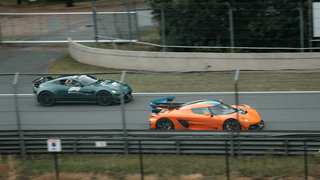
The primary concern for enthusiasts and industry experts was whether Lotus could deliver a car that felt as solid and reliable as a contemporary production vehicle. While the 2005 Lotus Elise remained minimalist, its attention to detail was impressive. The interior featured substantial use of structural aluminum, yet the fit and finish were precise. Every component felt securely integrated, dispelling any notion of a kit car.
The foundation of this confidence was the bonded aluminum chassis. This advanced structure, weighing approximately 150 pounds, provided a rigidity that is often challenging to achieve in open-top sports cars. This stiff platform allowed the sophisticated suspension—featuring Bilstein dampers and enthusiast-tuned ABS—to perform as engineers intended. The car was fitted with lightweight alloy wheels and custom-spec Yokohama tires, further optimizing its handling and responsiveness.
Toyota Power: A Harmony of Performance and Refinement
The mechanical heart of the U.S.-spec Elise was Toyota’s 1.8-liter 2ZZ-GE engine. This engine, also found in the Toyota Celica GT-S and Matrix XRS, was notable for its variable valve timing and lift (VVTL-i) system. This technology provided a seamless blend of strong low-end torque and thrilling high-end power, but the Lotus application transformed the engine’s character entirely.
In Toyota vehicles, the 2ZZ-GE often required revving hard, with a noticeable transition at high RPMs. However, the Lotus development team retuned the engine control computer to create a much smoother and more linear power delivery. The shift from low-speed to high-speed valve timing occurred earlier and more seamlessly, eliminating the typical “cam drop” that can disrupt the sensation of acceleration. This resulted in an engine that felt elastic, responsive, and genuinely joyful to drive—a feat that went beyond merely swapping an engine in a lighter vehicle.
The Driving Experience: A Return to Pure Sport
The true essence of the Elise lies in its handling, which was designed to be intuitive, communicative, and rewarding. The engineers at Lotus aimed to create a road car that felt like a Formula Ford racer—one that would respond instantly to driver input, forgive mistakes, and ultimately teach the driver how to improve their skills.
Stepping into the cockpit is a visceral experience. The low seating position, reminiscent of open-wheel racers, places the driver intimately connected to the road. The minimalist interior is efficient, with a focus on what matters for driving. The large windshield and rear roof hoop provide protection, and while rear visibility is limited, the seating position offers excellent visibility in all other directions. The upright, single-piece bucket seat is ergonomically designed to accommodate a wide range of body types, ensuring a perfect fit for every driver.
The engine starts with an eager but pleasing tone. The gear linkage and shifter are precise, offering a satisfying tactile connection to the mechanicals. The pedal spacing is intelligently designed, although drivers with wider shoes may find it tight. Once in motion, the Elise’s lightness becomes immediately apparent. The steering is light, direct, and precise, with little mass to move. At just under 2,000 pounds, the Elise feels incredibly agile, capable of changing direction on a whim.
With 190 horsepower, the Elise doesn’t rely on raw power to be fast. Instead, it utilizes its low weight to achieve impressive acceleration and handling. The manufacturer estimated a 0-60 mph time of 4.9 seconds, but this only hints at the car’s true capability. The throttle response allows drivers to influence the car’s attitude, providing a dynamic experience where the driver can manipulate the balance of the car at will.
Navigating the Driver’s Playground
On an autocross course, the Lotus Elise truly shines. Its neutral balance is evident, with equal grip between the front and rear tires. A slight increase in throttle results in predictable understeer, while lifting off the gas induces gentle oversteer that can be corrected with precision. Applying the throttle aggressively allows for controllable drifts, making the car accessible to both experienced racers and amateur drivers seeking thrills.
On public roads, the Elise remains an eager dance partner. It is agile and responsive in traffic, and always ready for an adventure. Freeway onramps become transformative experiences, as the car’s quick reflexes and acceleration make even everyday driving exhilarating. On winding country roads, the Elise flows gracefully or attacks apexes with the precision of a shifter kart—the driver is always in control, setting the pace.
The Cost of Simplicity: Utility vs. Performance
This pure driving experience comes at a price: the Elise is a strictly elemental form of transportation. It’s not designed for hauling families, carrying large cargo, or providing luxury. Its dimensions—149 inches long and under 44 inches tall—necessitate compromises in utility. For the right driver, however, these compromises are part of the appeal.
Lotus offers a Touring Pack for an additional $1,350 over the base MSRP of $40,780. This option includes leather seat faces, power windows, an upgraded stereo, additional carpeting, and sound deadening. While tempting, it detracts from the car’s fundamental character. Hand-crank windows are perfectly appropriate for a lightweight roadster, and the snug cockpit makes manual window operation effortless for both occupants.
More appealing for track-focused enthusiasts is the Sport Pack. This package features firmer suspension with greater adjustability and more aggressive Yokohama A048 tires on lighter forged-aluminum wheels. The rear wheels and tires remain 17×7.5 inches and 225/45, but the front wheels are upsized to 195/50-16 on 6.5-inch rims, increasing grip and oversteer. While the Sport Pack offers a noticeable performance advantage, it also results in a stiffer ride and heavier steering, making the base car a more approachable and enjoyable daily driver for many.
An additional option, the $1,475 hard roof panel, is a practical consideration for those living in regions with extreme weather conditions.
Market Success and the Future of Lotus
When the Hethel plant reached full production capacity, it was capable of producing 2,200 to 2,400 U.S.-spec Elises. At the time, Lotus’ 39 dealers already had approximately 2,000 orders placed. This high demand meant the cars would not be immediately available, requiring patience from buyers.
For enthusiasts seeking a light, responsive, and small sports car, the wait was well worth it. The Lotus Elise remained in a class of its own, regardless of price. Toyota’s own MR2 was underpowered, and the Mazda Miata, while a delightful sports car, lacked the Elise’s delicate balance and telepathic feedback. Even the newer turbocharged Mazda Miata (now referred to as the MazdaSpeed edition)